
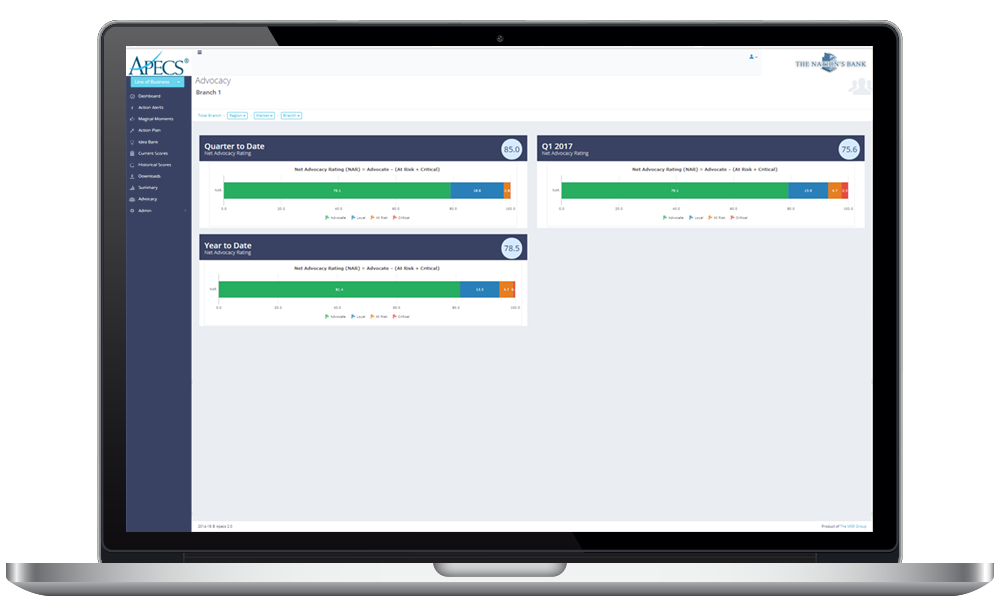
NAR® measures customer advocacy using likelihood to recommend and likelihood to do more business. It subtracts the percentages of Critical and At Risk customers from the percentage of Advocates.

How does it work?
The Advocacy Model is based on two key questions that determine:
- Customer likelihood to recommend your company to friends and colleagues
- Customer likelihood to do additional business with you in the future
The customer base is then segmented into four categories depending on their answers:
Advocates
Extremely loyal and willing to tell others about the organizationLoyal
Very satisfied and will continue to use the organization but won’t necessarily tell others about itAt Risk
Dissatisfied and considering looking for a new companyCritical
Most likely to leave and least likely to recommendThe APECS® customer experience measurement program tracks your efforts to increase advocacy through your Net Advocacy Rating (NAR®), calculated by simply subtracting the percentage Critical and At Risk from the percentage of Advocates. The NAR® is an enterprise-wide metric that identifies how successful you are in growing and maintaining Advocates. NAR® is a fluid measurement, as it is dependent upon the customer experience over time, which is why it is important to measure and track on an ongoing basis and report in real time.
Questions, answered.
How is Net Advocacy Rating calculated?
NAR® equals the percentage of Advocates minus the combined percentages of Critical and At Risk customers. Classification uses likelihood to recommend and likelihood to do additional business.
Is NAR® the same as NPS?
No. MSR’s Net Advocacy Rating uses two questions and four customer categories. Net Promoter Score uses a recommendation question and a different classification. Scores should not be treated as interchangeable.